Showing posts with label recurring program. Show all posts

Thursday, February 15, 2018

Mad Science: The Science of Sound

Today in Mad Science, we learned all about what makes sound happen. I remembered vaguely that there was a Magic School Bus episode about sound, so I took to the trusty Internet to locate it and show a clip that would explain vibration and sound waves better than I am able to. At the beginning of the program, I showed two videos.


The first video was the Magic School Bus clip I was thinking of. It does a great job explaining how vibration makes sound, and the basics of sound waves. The second video is from The Dr. Binocs Show, one I was not previously familiar with. I like this one because it also goes over vibration and sound waves, but then furthers the discussion by talking about matter and the absence of sound in the vacuum of space.

For our experiment today, we did a mini DIY musical instruments lab. First we made a harmonica out of tongue depressors and rubber bands. I did this as a step-by-step workshop, not telling the next step until everyone had completed the current one. This way, no one got to the end and started playing their harmonica too early.


While it was difficult to teach while the kids were excited about making noise, I opened up a discussion about the construction of our harmonicas. What did the kids think could be done differently to produce a louder sound? A different pitch? What would happen if we removed the paper from inside?

They decided that the paper creates space between the sticks, which is necessary to create a vibration on the rubber band. According to the videos we watched, vibration is required for sound to happen. A couple of them constructed a second harmonica with no paper, and their hypothesis was proved correct!

Our second experiment was a buzzing noise maker made with index cards, string, pencil-top erasers, and rubber bands. There is a great entry with a video on What We Do All Day that explains exactly how to make it. I did this project step-by-step as well, and didn't tell the kids that the aim was to spin it and make it buzz until everyone's was complete.
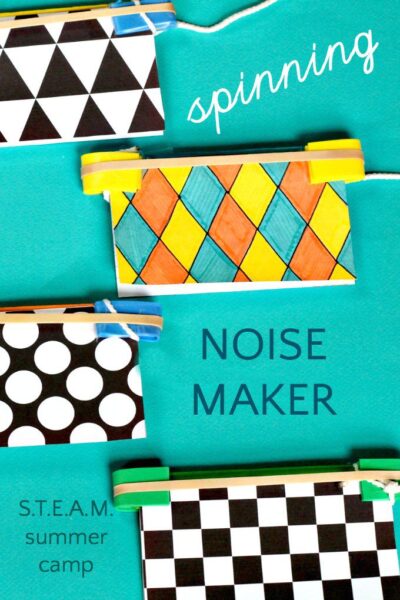
Science experiment for kids. How to make a spinning noise maker.

Like we did with the harmonica, I took a few minutes to talk about why the construction of this instrument works the way it does. We quickly identified the source of vibration, and also like the harmonica, realized that removing the index card stops the vibration, and therefore, the sound.

At the end of the program, we watched the two videos again for the handful of late-comers who missed them at the beginning. The kiddos were delighted to bring their buzzy new toys home, and I officially feel like a science teacher.

Wednesday, November 15, 2017

Mad Science: Cranberry Chemistry and Architecture

Once again, in today's Mad Science we had two experiments. The first one focused on chemical reactions, and the second was a hands-on skill builder to practice spatial relations and exercise motor skills. I should note, I did not plan this program on my own. My partner youth librarian Sara is out with an unexpected illness this week, and I have been taking over her programs. She planned this and left me all the materials, so this morning my only job was to read up on the scientific concepts and carry out the program. We did cranberry-theme experiments today, to be festive and Thanksgiving-y.

Here is experiment one: Cranberry Chemistry.

Materials needed:

  • Cranberry juice (unsweetened or no sugar added)
  • Lemon juice
  • Baking soda
  • Clear plastic cups
The lesson for this experiment is to learn about the chemical reactions between acids and bases. It helps to have the visual aid of a pH scale on the wall, and talk to the kids about acidic, basic, and neutral liquids. It also helps to label where the liquids you'll be working with fall on the scale. I labeled where baking soda (9, very basic) and lemon juice (2, very acidic) are. I drew one on the white board, based off this picture:

Image result for ph scale

First, we poured some cranberry juice into our cups and noticed that it is a dark red color. We talked about the fact that cranberries are an acid because they contain anthocyanins. We repeated that word a whole bunch, because it's long and hard to pronounce. I also wrote it on the board so they could sound it out if they were visual learners.

ANTHOCYANINS!

Anthocyanins are pigments that change color depending on whether they are reacting with an acid or a base. Cranberries, and therefore cranberry juice, naturally contain anthocyanins. 

After the cranberry juice was poured, we added a small amout of our base: baking soda. The juice is supposed to turn bright blue; we got as far as a half-hearted purple color. So technically the experiment worked, and it worked well enough to prove the scientific fact of anthocyanins true, but it was not the exciting and vibrant color I had hoped for.

The next step was to add another acid, lemon juice, back to the solution and watch it turn back to it's original red. This also pretty much worked. We did end up with cups full of red liquid again, and were able to discuss how the ANTHOCYANINS reacted with the acid in the lemon juice. 

Here is experiment two: Cranberry Architecture.

Materials needed:
  • Fresh cranberries
  • Toothpicks
The lesson for this experiment was mostly just to have fun. I demonstrated making a simple cube with the cranberries and toothpicks, then invited the kids to make one too. After they all mastered the cube, I gave them about 10 minutes to make whatever they wanted. 

Image result for cranberry toothpick architecture
Source: Little Bins for Little Hands
Then, I issued the kids a challenge: build the highest structure you can that will support the weight of a jumbo marshmallow. I gave them 10 more minutes to alter their creative structure, or tear it down and start something brand new. Then, after everyone was done, I balanced a marshmallow on the highest point of each one. Here is our winner with her giant cranberry tower! If you look closely, you can see that there are actually TWO marshmallows nestled in between the toothpicks. (I did get permission from her guardian for the picture to be posted).


I liked the cranberry architecture because it helps kids of all ages and developmental stages enhance their fine motor skills, motor planning, and spacial relations. It also helps them gain patience with manual projects and maximizes finger dexterity, which will come in handy for crafting, playing musical instruments, and typing. 

Here is the hand out that I sent home with each child, telling them about the experiments we did in case they want to recreate them at home. Click the image for a closer view.

Mad Science is a challenging program for me to host. I have never been very science-minded, so all my scientific information comes from Google and all my ideas for this program come from Pinterest. However, I had a great time working with these kids doing the cranberry experiments today. Programs like this, with more structure and smaller groups of participants, are great because you get more one-on-one time with the patrons. It's more like being a classroom teacher. I've said it before, but that's one big reason why I love being a librarian: you get the best of all educational worlds!

Thursday, November 9, 2017

Write Your Own Picture or Comic Book - Week Two

This is week two of a four-week writing program for tweens age 8-12.
Week One
Week Three
Week Four

Last week we had four extra kiddos who didn't sign up, and today we had five more! While we can technically turn people away from an event when they have not registered, I hate to tell anyone they can't participate in a library program. Counting some parents who wanted to stick around and watch, we filled our tiny room with twenty people not including myself! All twelve laptops were out and running, with sibling sets sharing again.

Our icebreaker today was another Wacky Web Tale from Eduplace. Today's puzzle was called "Could it Really Happen," and since we used it as an ice breaker, I asked that each child fill in their own name for "friend." They worked on it for 15 minutes, then had a chance to share with the group.


After everyone shared, I brought attention to how different every single story was. Even though they all filled out the same form, the adjectives and nouns and verbs they chose made them completely different stories! This point segued nicely into the next activity of the day, learning about plot structure.

I doctored up this image to include definitions, and then shared it with them on a PowerPoint:


I picked five readers, and had each one read a different definition out loud to the rest of the group. Then, I asked each of them to think about a story they had read lately, and fill in the plot points to each definition. One of the kids was really excited about the book Wonder by RJ Palacio, so I asked him to go through each point in the plot diagram and tell me which parts of the story match up. He came up with:

Exposition: Augie has had a lot of surgeries because of a facial deformity, and has never been to real school.
Rising Action: His parents decide to send him to school, where he meets some kids who are nice and others who are bullies.
Climax: He finds out that one kid who he thought was a friend is actually a bully, and makes fun of Auggie behind his back.
Falling Action: With the help of his friend Summer, Auggie thinks about how everyone should just choose to be kind to one another. His "bully" friend apologizes and they become friends again.
Resolution: The school year ends, and some of the kids show they have learned to become a little kinder through their made-up precepts assigned by their teacher.

After this completely stellar example, I set the kids free with laptops, pencils, and notepads, with instructions to come up with their own story that fits into these five plot points. It could be a true story, something that has happened to them, or something they made up. A couple of the kids had some trouble getting started, but for the most part they were able to fit the happenings of their story into these boxes. I'm excited that they all seemed to understand the concept as they worked on their stories!

Thursday, November 2, 2017

Write Your Own Picture or Comic Book - Week One

This is week one of a four-week writing program for tweens age 8-12.
Week Two
Week Three
Week Four

I required registration for this program, because there is a limited amount of space where we held it. Also, I decided partway through the planning that we would be using laptops, and my library only owns twelve laptops.

As of yesterday, the registration was full at twelve participants plus two on the waiting list. Ten of the registered kids showed up, plus four that I was not expecting. Even though two were without laptops, there were chairs for everyone so I invited them all inside.

Our first activity was on Houghton Mifflin Harcourt's website Eduplace, and was basically an online version of MadLibs called Wacky Web Tales. With two sets of siblings sharing a laptop, I challenged the kids to find the website and then fill out the tale entitled "The Box." Since we used this as an ice breaker activity, I told them that their own name had to appear somewhere in their tale. They had 15 minutes to fill it out, then we went around and shared.


For the rest of the session, I let them work on their choice of two websites: Story Jumper or Storyboard That. Story Jumper presented the unexpected complication of needing users under 12 to go through a long and involved process to get parent permission to use the website, so most of the kids ended up on Storyboard That for today. They had a great time making their own comic strips, and exploring the website. Here is my example strip that I created on Storyboard That:


I feel that it's important to let tweens and even older elementary schoolers explore the internet in an only somewhat structured environment. This way their activity can still be monitored, but they figure out how to browse and make things happen on their own. I originally had a more regimented lesson plan for today, but because it was the first session, I thought it would be fun for them to look at character and setting options without putting too much pressure on the session.