Showing posts with label community. Show all posts

Thursday, October 4, 2018

Welcome, Fall! Leaf Art

As the deadline to plan October programs approached, I realized I wasn't doing anything seasonal except the big Halloween storytime we do yearly. In the interest of trying to make myself more excited about Fall (it's getting cold and the trees are dying...yay?) I decided to put together a fun Fall craft program.

We had three stations: crayon rubbings, torn paper trees, and painted leaf prints. I structured this program as a drop-in for an hour and a half, and over 30 people came to make leaf art with me! This was a fun, easy program that I put together with things we already had in our supply room. If you want to recreate it, here is a supply list:

Crayon Rubbings
Crayons
Paper
Leaf Rubbing Plates

Torn Paper Trees
Torn construction paper in Fall colors
Brown construction paper for trunk
White paper for background
Glue sticks
Scissors

Painted Leaf Prints
Washable paint in Fall colors
Paper
Artificial Leaves

Also, it's becoming a wonderful theme that the kids who come to my programs are more creative than I am. Some of them figured out that the Leaf Rubbing Plates also make great paint prints! Here are some of the gorgeous finished products they made.
Torn paper tree and rubbings examples and supplies

Leaf print example and supplies

Artists at work

Artists at work
Finished torn paper tree

Finished leaf prints and paintings

Finished torn paper tree

Finished crayon rubbing

Finished torn paper tree

Finished torn paper tree

Finished art drying after the program

Friday, September 28, 2018

Kids Decorate the Library

I wasn't sure what I was getting into with this program, but by the end it turned out to be one of my favorites! The concept was simple: Set out a bunch of random craft supplies and large pieces of butcher paper, and let the kids make whatever they wanted with the intention of beautifying our library.

I had some pre-cut paper pieces in the shape of butterfly wings, rectangles, circles, flower stems (the rectangles and circles can be strategically placed to look like a flower), and triangles. I was delighted to find the kids took these and ran with them! Some copied my sample flowers and butterflies, and others went off the map completely, turning the circles into caterpillars and other incredibly creative things I would never have thought of. This is proof of what I have been saying since last October's Mad Science: children are more creative than I could ever hope to be. That's why I've started structuring my programs a lot less, and just letting them run with the supplies I put out to see what they'll come up with.

I also printed a large banner in 11x17 pieces and set it out on the table for anyone to color. After the program I put the banner together and laminated it to hang up with some of the art. Here are the creative and colorful results:

Some of our first attendees starting their projects

Busy artists at work

Batman made a caterpillar!

A teen volunteer coloring the banner

Finished decorations!

Finished decorations!

Finished decorations!

Finished decorations!

Banner after I attached and laminated it

Tuesday, July 31, 2018

Education: What to Expect

The premise of this program was simple.

  1. Form a panel of 5-8 high school juniors and seniors.
  2. Acquire an audience of incoming high school freshmen.
  3. Take questions from the audience and have the panel answer.
In execution, the program worked almost as well as I had hoped. I was lucky enough to run it two times, both with very different results.

The first time I ran the program, it was at my library. Since it was still summer I had all 35 of my teen volunteers at my disposal so finding the panel was easy. Six signed up and five actually attended, which you know is pretty good odds if you've ever worked with teens. The audience members consisted of two other teen volunteers who were about to enter high school, and one new kid who I had never met before. With an evening teen program two weeks before the beginning of the school year, I considered one brand new patron a major success.

When the participants walked in, there was a pile of paper slips and pens, along with a box to deposit any questions they wanted to ask anonymously. I had also stuffed the box with some questions in case attendance was low.

The "panel" set-up was quickly changed by the teens to a more informal seating arrangement. They decided that since there were only 8 of them, they would rather put their chairs in a circle so everyone could see everyone. They all introduced themselves with their name, school, grade, and whether they were a member of the audience or the panel. Then panel members took turns answering questions from the box, and some that the younger kids asked out loud after the ice was broken and they were feeling less shy. It turned out that most of the kids in the room were students at the closest high school to our branch, so they all had a lot of specifics to talk about: teachers to avoid, which extracurricular activities and clubs were worth the time, dress code, etc. After all the questions were answered the group got some time to mingle with cookies and hot drinks. It was a very small, but overall successful and positively received program.

The second time I did this program, it was entitled "Eductaion: What to Expect." I did it with my One N Ten outreach group, which has kids ages 12-24 and tends to tip the scale toward the older end. Most of those kids are older high school students, or already in community college or the workforce. "What to Expect in High School" wouldn't have kept their interest for very long since most of them have been through that stage in life already, so the group facilitators helped me tweak it to their needs.

The One N Ten group is quite large, usually between 30 and 40 youth, so I took volunteers who thought they'd like to answer questions about the following four subjects:

  • High school
  • Community college and/or 4-year university
  • Straight from high school to the work force
  • Trade school as opposed to traditional college
There were several volunteers for each, so we took the panels in shifts. Four at a time, one youth to speak on each subject took a spot in one of the four "hot seats" set up in front of the rest of the group. Each member of the group, whether they were speaking on a panel or not, were asked to write down a question on one of the topics. After collecting all the questions, I sorted them into categories and asked each member of the panel one question on their topic. After each member had answered one question, they switched out and the next four got a turn. We did this four times, with 16 youth getting a chance to speak to the group about their own experiences, before group time was up for the night.

Seeing this program happen twice in two drastically different settings was so rewarding. The smaller program that took place inside the library focused mostly on one particular high school, and it was great to see the younger kids making connections with upperclassmen and watching first-day anxiety melt away as they heard that high school won't be that scary after all.

The large group at One N Ten was a breath of fresh air in terms of people telling their success stories that have nothing at all to do with a traditional college path. As someone who was privileged enough to go to a 4-year college straight out of high school, and then continue on to higher education after than before landing a professional career very quickly, I don't feel qualified to speak on the who, what, where, and how of things like community college, trade school, and working full-time straight out of high school. However, I want to present all of these options as real and valid for the youth that I work with, because college is incredibly expensive and not the right path for everyone, especially depending on what field you want to enter.

I have found that the best teen programs are the ones where I hardly talk at all. I love to ask a question, share some of my own insight if necessary, but mostly let the teens talk among themselves on the given topic. They have so much knowledge and have lived a fair amount themselves, even though they are young. I love letting them talk, because the younger you are, the less frequently you are given that opportunity. In programs like this, my only rule is one I actually borrowed from One N Ten because it perfectly sums up how to give respect to your fellow participants: One Diva, One Mic.

Friday, May 25, 2018

Patron Interaction: Picking Up Lots of Things

There is a family who regularly attends storytime: a mom, 4-year-old twins, and a toddler who is about 2. The twins, one boy and one girl, are incredibly smart and advanced for their age. The boy could sit down and read an entire picture book from cover to cover when he was three. They are also pretty calm and reserved, preferring to stay on mom's lap or on the outskirts of the group when we sing and dance in storytime.
On Wednesday, the whole family came to Toddlertime, which once again includes a 15-minute toy session at the end. When clean-up was finished the boy twin came up to me with a very concerned look on his face. I knelt to his level and held both of my hands out. He placed one hand in each of mine, very delicately. I asked him what was wrong.

"UM," he said. "I only got to pick up one thing. I wanted to pick up lots of things."

From getting to know this family over the last year, I know it's extra important to this little guy that he has items and experiences that are just his own, because he has to share so much with his twin sister. I told him that if he came back on Friday (today) for Shake, Boogie, and Bop, he could be an extra good cleaner-upper when we played with egg shakers.

Flash forward to today. The Shake, Boogie, and Bop group were fairly raucous. We didn't get to the point in the program where I would have brought out the egg shakers, and I'm glad we didn't, because there were some older boys in there and I was having psychic visions of egg shakers being hurled full-throttle at their brothers' heads. The twins, their baby sister, and their mom were exemplary storytime goers as usual. After we sang our goodbye song and had bubbles, most of the crowd left, but this family stayed behind to chat as they sometimes do.

I brought out the box of egg shakers and set it on the floor. I asked the boy if he would help me sort the shakers and put them back in their box, since we didn't get a chance to use them in class. He and both of his sisters excitedly organized the shakers by color on the floor, then gingerly placed each one back in their bin.

Before they left, I asked him if this satisfied his urge to put away lots of things. He answered with an uncharacteristic yelp of "YES!" He was, however, not nearly as enthusiastic when I suggested he tell his mom he wanted to help clean up lots of things at home, too.

Wednesday, April 11, 2018

National Pet Day

This program started out as a small idea, and morphed into a pretty big deal by the time it was planned and ready to go. I follow several "daily holiday" web pages that list all the local and national silly holidays, because this sometimes gives me program ideas. It's how I thought of Make a Grandparents Day Card, for example. A few months ago I noticed that National Pet Day was coming up in April. We had done dog toy making as a teen activity last summer and it went over pretty well, so I thought about combining that with a few other stations and having a National Pet Day celebration at the library.

Because the library is a city entity, I contacted the City of Mesa Animal Control Department to see if they had any advice, resources, or even a representative they could send out on the day of the program. They got really excited about the program, and said they would send one human representative from their department and at least one furry friend. Of course, the exciting idea of a dog or cat in the library got the community buzzing.

My mom also happens to be a professional dog toy maker. She knows the exact right size and type of fleece strips to make the perfect long-lasting tug toy. Luckily she was available to help, so she set up at a table and guided kids in braiding their colorful creations. At the end of the night, we had over 30 tug toys to donate to homeless dogs at Animal Control.

The best part was, the Animal Control department totally came through with their furry friends! Their rep brought three seven-week-old gray kittens! I'm a dog person, but the kittens were the best thing that has happened to me this year. Adorable. 

In the end, we had an attendance count of 94 people! In my previous experience this is almost unheard of for a weekday evening program. The Vice Mayor of Mesa even stopped by and featured us on his Twitter, and Nearby News was back to photograph for another feature. 


Also, enjoy these pictures I took during the event (with parent permission, of course). I especially love the action shot of the two kittens wrestling.

One of our librarians cuddling a kitten

Showing off a finished pet toy


KITTEN BATTLE!

Showing off a finished pet toy


This guy was so excited to meet a kitten!

One of our regular patrons meeting a kitten

One of our pages cuddling a kitten

Watching the kittens play

Vice Mayor Luna meeting people

I even made it into a picture!

Thursday, February 15, 2018

Mad Science: The Science of Sound

Today in Mad Science, we learned all about what makes sound happen. I remembered vaguely that there was a Magic School Bus episode about sound, so I took to the trusty Internet to locate it and show a clip that would explain vibration and sound waves better than I am able to. At the beginning of the program, I showed two videos.


The first video was the Magic School Bus clip I was thinking of. It does a great job explaining how vibration makes sound, and the basics of sound waves. The second video is from The Dr. Binocs Show, one I was not previously familiar with. I like this one because it also goes over vibration and sound waves, but then furthers the discussion by talking about matter and the absence of sound in the vacuum of space.

For our experiment today, we did a mini DIY musical instruments lab. First we made a harmonica out of tongue depressors and rubber bands. I did this as a step-by-step workshop, not telling the next step until everyone had completed the current one. This way, no one got to the end and started playing their harmonica too early.


While it was difficult to teach while the kids were excited about making noise, I opened up a discussion about the construction of our harmonicas. What did the kids think could be done differently to produce a louder sound? A different pitch? What would happen if we removed the paper from inside?

They decided that the paper creates space between the sticks, which is necessary to create a vibration on the rubber band. According to the videos we watched, vibration is required for sound to happen. A couple of them constructed a second harmonica with no paper, and their hypothesis was proved correct!

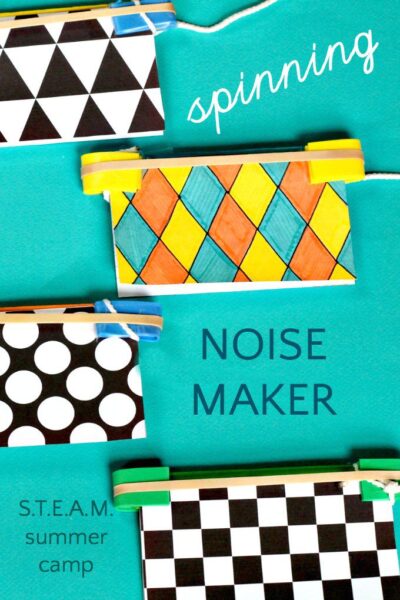
Our second experiment was a buzzing noise maker made with index cards, string, pencil-top erasers, and rubber bands. There is a great entry with a video on What We Do All Day that explains exactly how to make it. I did this project step-by-step as well, and didn't tell the kids that the aim was to spin it and make it buzz until everyone's was complete.

Science experiment for kids. How to make a spinning noise maker.

Like we did with the harmonica, I took a few minutes to talk about why the construction of this instrument works the way it does. We quickly identified the source of vibration, and also like the harmonica, realized that removing the index card stops the vibration, and therefore, the sound.

At the end of the program, we watched the two videos again for the handful of late-comers who missed them at the beginning. The kiddos were delighted to bring their buzzy new toys home, and I officially feel like a science teacher.

Wednesday, February 14, 2018

Valentine's Day Party

I have to start by telling you how many people came to this program, because I still can't quite believe it myself: 111! That's not a typo. There were one hundred and eleven people in the children's area of our library this morning!

I think the high attendance was helped by the fact that we had this party directly after Toddler Time. But, I also think our fun seasonal parties have been talked up, and the news has spread among local parenting circles after our extremely successful Snow Day program (which I did not write up because I didn't really have a hand in planning it... But I probably will next year, so stay tuned until December 2018).

Our Valentine's Day Party had four major components: book display, refreshments, Valentine card making, and games.

For the cards, we set out art supplies and some die-cut hearts and other shapes. The refreshments were those delicious soft grocery store sugar cookies, and juice boxes. Neither of these need much more explanation, and I also forgot to take any pictures (I was too busy counting all ONE HUNDRED AND ELEVEN of our guests!).


We also had two games available to play: Valentine I Spy, and Pin the Kiss on the Frog.

Here are the Valentine I Spy pages procured from Live Laugh Row, printed on 8.5x11 paper and left on tables for kids to play together, alone, or with their grownups:

The perfect way to entertain the kids for Valentine's Day! This sweet Valentine's Day I Spy Printable come with an answer sheet and answer key too! Print yours at livelaughrowe.com #valentinesday #ispy #printable

Pin the Kiss on the Frog was more of a group game, and unfortunately it did not get played. However, Mr. Frog made a great party decoration, and has now found a semi-permanent home on our Spring Into the Library bulletin board display.


The kids had a great time making valentines and eating their treats. I even saw a few books get checked out!

Here is a partial list of the Valentine's books we displayed:
  • It’s Valentine’s Day—Prelutsky 
  • Groggle’s Monster Valentine—Murray 
  • I Love You, Dear Dragon—Hillert 
  • Here Comes Valentine Cat—Underwood 
  • It’s Valentine’s Day, Chloe Zoe!—Smith 
  • Love You Always—Chapman 
  • Mr. Goat’s Valentine—Bunting 
  • Happy Valentine’s Day, Mouse!—Numeroff 
  • A Crankenstein Valentine—Berger 
  • Llama Llama I Love You—Dewdney 
  • The Yuckiest, Stinkiest, Best Valentine Ever—Ferber 
  • Panda’s Valentine’s Day—Morrow 

Friday, February 2, 2018

Bird Feeder Challenge

February is National Bird Feeding Month! This was a very cool program conceived and planned by Sara, but carried out by me because she was out sick. I actually debated posting it on my blog because this program was not technically mine, but I love the idea and the pictures of all the kids with their finished bird feeders. I figure as long as I don't take credit for the idea, we're good to go.

The Bird Feeder Challenge was a program for school-age kiddos, and had three basic parts. First, we talked about all the aspects that make up a good bird feeder, and why. Second, the kids had some time to make their own bird feeders out of found objects, Crisco (in lieu of peanut butter in case of allergies), and bird seed. Third, each child got a chance to stand up in front of the group and tell us about their bird feeder.

First, we made a list of everything a bird feeder needs to be successful. Here is what they came up with:


I left this list up so they could refer back as they constructed their own feeders. 

The building process:


After the building time was over, some of the kids were reluctant to tell everyone else about their creation. A couple of them preferred to sit instead of stand, but eventually all twelve kiddos told us where the bird(s) stand, how they get their food, and what is special about their creation. 

In addition to being lots of messy fun, there was an important educational element to this program. The actual construction of the bird feeders encourages STEAM concepts such as engineering and architecture. 

If I were to do this program again, the only thing I'd change is taking a little more time at the beginning to talk about bird feeder construction before launching into the list-making. Luckily this group all had a pretty good idea of what a bird feeder is, but not all kids do. This was actually a suggestion made by a mom. I learn something new with every program I present!

Here are some of the kids with their finished bird feeders (posted with parent permission).