When the kids walked into the room, I had it split in half using dividers. On one side of the room there were tables set up with four cups per station, and four candy corn pumpkins in front of the cups. These stations also included a pencil and a half-sheet worksheet that I made (click to see larger image):


After all the kids came in and got settled, I poured a small amount of each liquid into each of their four cups: vinegar, hydrogen peroxide, canola oil, and rubbing alcohol. After everyone had all their liquids, I let them (gently!) drop one pumpkin into each cup.
We talked about what we saw happening right away. Some of the pumpkins were bubbling slightly. Others had turned on their side. Still others had a small amount of their coloring floating off of them already. I asked the kids to make their predictions based on what was already happening to the candy. They all thought the rubbing alcohol pumpkins would dissolve completely in half an hour, but weren't sure about the rest of the liquids.
At this point, we moved to the other half of the room. It was set up with clear tubs filled about halfway with water, a new half-sheet worksheet (click to see larger image), and a selection of wrapped Fun Size candy on the tables. After they chose their stations in the new part of the room, I explained that we would be doing a float/sink experiment while we waited for our pumpkins to change.
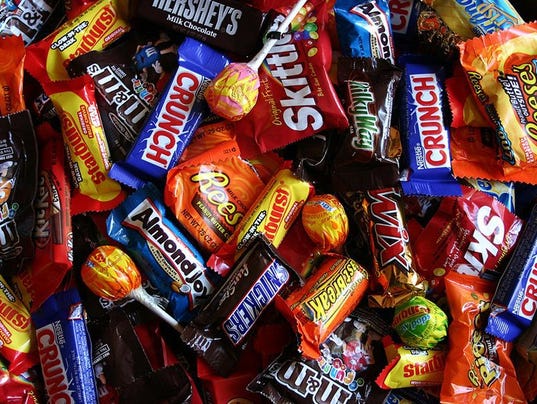

I talked for a brief moment about density. I don't like to do very intense science lessons in this program, but it is nice to give them some vocabulary words and write them on the board so they know what they're seeing while it's happening. We learned that if something is more dense, it sinks, and if it's less dense, it floats. We talked about what can make an item less dense, like having air pockets or being hollow even if it is solid (a good segue into talking about the Three Musketeers candy later... MillenniaLibrarian thinks ahead :p).
As a group, we predicted whether we thought the Fun Size Starburst candy would float or sink in the water. I had them circle their prediction, and also took a vote and wrote how many of our group members thought the candy would float vs. sink. We had some food allergies in the group, so it was up to each child whether they would unwrap their candy or not.
When I tried this experiment earlier today, all the candies sunk except the Three Musketeers, which floats because of their air pockets in its filling. However, I was experimenting with all the candies unwrapped. When I heard a shriek halfway through testing the Starburst, I thought someone had splashed water on themselves. They were actually shrieking from pure delight because their wrapped candy was floating, while their neighbor's unwrapped one had sunk! It didn't even occur to me to try them both wrapped and unwrapped.
As a group, we figured out that when they were unwrapped, every candy except the Three Musketeers sinks, but all of them float when they are still in the wrapper. The kids decided this must be because of the air trapped inside the sealed plastic wrappers. I love that this happened, because they taught me something I hadn't even considered when planning this experiment.
After our amazing density discoveries, we came back to our pumpkin cups to judge their progress and fill our our other worksheets. I wasn't able to get any pictures of our experiment, but here is one from the website I lovingly stole the idea for the experiment from, Lemon Lime Adventures:
 |
| Source: Lemon Lime Adventures |
In the experiment example I followed, the pumpkins were fished out of their liquids and copied in drawings. For my program, we left the pumpkins in, but did draw them after their time in the cups and observe how they changed.
 |
| Source: Lemon Lime Adventures |
I believe my Halloween candy experiments were a hit with all the 6-12-year-olds who came to my program today. I have to admit that Mad Science isn't my favorite program to run because of the science aspect (I am a humanities girl all the way), and how structured it needs to be in order to work as an hour program. However, the kiddos always have a good time. I will leave you with this cute conversation I had with a third grader after the program.
Kid: Are you a science teacher?
Me: Today I am.
Kid: What about the other days?
Me: I'm a librarian.
Kid: What does that mean?
Me: It means I'm an everything teacher!
Kid: And you give books too?
Me: Yeah, I give books too.
Kid: Are you a science teacher?
Me: Today I am.
Kid: What about the other days?
Me: I'm a librarian.
Kid: What does that mean?
Me: It means I'm an everything teacher!
Kid: And you give books too?
Me: Yeah, I give books too.


No comments:
Post a Comment