Showing posts with label engineering. Show all posts

Thursday, February 15, 2018

Mad Science: The Science of Sound

Today in Mad Science, we learned all about what makes sound happen. I remembered vaguely that there was a Magic School Bus episode about sound, so I took to the trusty Internet to locate it and show a clip that would explain vibration and sound waves better than I am able to. At the beginning of the program, I showed two videos.


The first video was the Magic School Bus clip I was thinking of. It does a great job explaining how vibration makes sound, and the basics of sound waves. The second video is from The Dr. Binocs Show, one I was not previously familiar with. I like this one because it also goes over vibration and sound waves, but then furthers the discussion by talking about matter and the absence of sound in the vacuum of space.

For our experiment today, we did a mini DIY musical instruments lab. First we made a harmonica out of tongue depressors and rubber bands. I did this as a step-by-step workshop, not telling the next step until everyone had completed the current one. This way, no one got to the end and started playing their harmonica too early.


While it was difficult to teach while the kids were excited about making noise, I opened up a discussion about the construction of our harmonicas. What did the kids think could be done differently to produce a louder sound? A different pitch? What would happen if we removed the paper from inside?

They decided that the paper creates space between the sticks, which is necessary to create a vibration on the rubber band. According to the videos we watched, vibration is required for sound to happen. A couple of them constructed a second harmonica with no paper, and their hypothesis was proved correct!

Our second experiment was a buzzing noise maker made with index cards, string, pencil-top erasers, and rubber bands. There is a great entry with a video on What We Do All Day that explains exactly how to make it. I did this project step-by-step as well, and didn't tell the kids that the aim was to spin it and make it buzz until everyone's was complete.
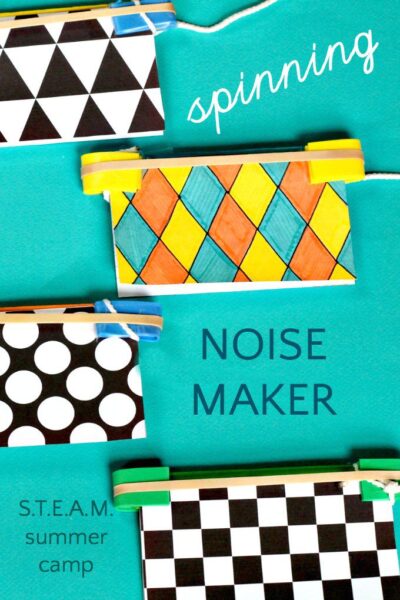
Science experiment for kids. How to make a spinning noise maker.

Like we did with the harmonica, I took a few minutes to talk about why the construction of this instrument works the way it does. We quickly identified the source of vibration, and also like the harmonica, realized that removing the index card stops the vibration, and therefore, the sound.

At the end of the program, we watched the two videos again for the handful of late-comers who missed them at the beginning. The kiddos were delighted to bring their buzzy new toys home, and I officially feel like a science teacher.

Friday, February 2, 2018

Bird Feeder Challenge

February is National Bird Feeding Month! This was a very cool program conceived and planned by Sara, but carried out by me because she was out sick. I actually debated posting it on my blog because this program was not technically mine, but I love the idea and the pictures of all the kids with their finished bird feeders. I figure as long as I don't take credit for the idea, we're good to go.

The Bird Feeder Challenge was a program for school-age kiddos, and had three basic parts. First, we talked about all the aspects that make up a good bird feeder, and why. Second, the kids had some time to make their own bird feeders out of found objects, Crisco (in lieu of peanut butter in case of allergies), and bird seed. Third, each child got a chance to stand up in front of the group and tell us about their bird feeder.

First, we made a list of everything a bird feeder needs to be successful. Here is what they came up with:


I left this list up so they could refer back as they constructed their own feeders. 

The building process:


After the building time was over, some of the kids were reluctant to tell everyone else about their creation. A couple of them preferred to sit instead of stand, but eventually all twelve kiddos told us where the bird(s) stand, how they get their food, and what is special about their creation. 

In addition to being lots of messy fun, there was an important educational element to this program. The actual construction of the bird feeders encourages STEAM concepts such as engineering and architecture. 

If I were to do this program again, the only thing I'd change is taking a little more time at the beginning to talk about bird feeder construction before launching into the list-making. Luckily this group all had a pretty good idea of what a bird feeder is, but not all kids do. This was actually a suggestion made by a mom. I learn something new with every program I present!

Here are some of the kids with their finished bird feeders (posted with parent permission).