Showing posts with label teenagers. Show all posts

Tuesday, July 31, 2018

All About Teen Volunteers

This summer, I was tasked with being in charge of the teen volunteers. If you've ever worked in (or visited) a public library in June and July, you've probably been at least peripherally aware of teen volunteers working there. They are incredibly important to making the Summer Reading Program happen because it is, as I lovingly refer to it, the children's librarian Olympics. We are constantly running, programming, craft-prepping, and helping patrons at a wildly accelerated rate. We couldn't do it if it weren't for those amazing teenagers who need community service credit to graduate high school (and/or are just good people who want to help out) (and/or couldn't find a paying job and their parents want them doing something over the summer). Whatever the reason, we're thrilled to have them.

After our system's volunteer coordinator forwarded me all 30-odd applications, I sent out two emails. The first was to people who had never volunteered here before, asking them to come in for an interview. I set aside a couple of Saturdays and scheduled four teens per hour. I saw each of them for 10-15 minutes, during which time I asked them a few questions to get to know them better and find out where they would be best suited to work in our library. I didn't turn anyone away; simply presented them with the forms to get their badges and welcomed them into the program. I consider the interview more of a formality than a necessity; it gives the kids job experience and gives me a chance to meet them one-on-one before the summer starts.

The next step was to organize a mandatory orientation. I had one on a weekday evening and the other on a Saturday morning, and let all 35 volunteers know that attending one or the other was a requirement for participating in the program. Orientation included individual introductions, icebreaker games, popcorn reading off a PowerPoint to make learning the rules a little more engaging, and then standing up for a high-energy shelving activity lead by the manager of our pages. At the end, one of our other children's librarians ran a Jeopardy-style trivia game about the rules we had discussed earlier in orientation.

The best part of orientation was inviting any staff member who wanted to attend. This had not been done in the past, which caused a bit of a disconnect between non-youth services staff and the volunteers. This year, several managers and librarians from other departments attended, which was great for both sides to get to know one another.

Once everyone was oriented, I made schedules for the SRP desk, weekly storytime helpers, and one-time program assistants. Some of the scheduling was done manually in Excel, and for other parts of it I used SignUpGenius.com. Something new that I implemented this year was a daily reminder email sent out to all teens who would be working the next day. I found this cut down on the kids forgetting their shifts or being late.

Possibly the biggest bummer of facilitating teen volunteers is keeping track of discipline. We did have several instances of volunteers having their phones out during programs or desk shifts, which can become a disciplinary offense if it happens a lot. The bigger infractions were being late or missing a shift without calling; we made it clear that two no-call-no-shows equals termination, and there were two instances of this over the summer. In terms of discipline, our entire department learned that we will need a more consistent flow chart for next summer. 

The best part was pinpointing the volunteers who exhibited leadership skills and having the bility to give them more to do. For example, three of our most dedicated volunteers were my assistants during Theater Day Camp, where they often lead games and acting lessons while I only supervised. I loved seeing these young people blossom into leaders!

An important end-of-summer ritual is the teen volunteer thank you party! All three of our children's librarians worked together to plan the party complete with food, gifts, and activities for the kids to enjoy. The party was held after-hours in the library, and they got to run wild in the empty stacks for a scavenger hunt! After that we had dinner and a karaoke party in the Program Room.

I am excited to say that overseeing the teen volunteers is something I will continue to do throughout the 2018-19 school year, so I might be posting updates about our year-round volunteers periodically!

Saturday, May 26, 2018

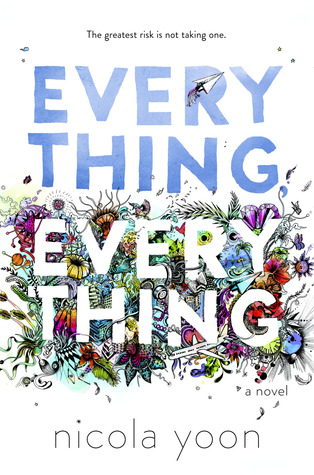
Book Review: Everything, Everything

It's recently come to my attention that I love doing book reviews where I can talk about the movie or TV show adaptation as well (see Th1rteen R3asons Why by Jay Asher). I am planning to do a review of Simon vs. The Homo Sapiens Agenda as well, but I just finished Everything, Everything this morning and the ending gave me chills. I had to write about it right this second.

WARNING: SPOILERS ARE COMING. If you haven't read the book, you will learn things you shouldn't until the end of the book. Read the book or watch the movie, then come back and read this entry.

Book info:
Title: Everything, Everything
Author: Nicola Yoon
Year Published: 2015
ISBN: 9780553496642
Interest Level: Grades 9-12

Plot Summary (From Goodreads):
My disease is as rare as it is famous. Basically, I’m allergic to the world. I don’t leave my house, have not left my house in seventeen years. The only people I ever see are my mom and my nurse, Carla.

But then one day, a moving truck arrives next door. I look out my window, and I see him. He’s tall, lean and wearing all black—black T-shirt, black jeans, black sneakers, and a black knit cap that covers his hair completely. He catches me looking and stares at me. I stare right back. His name is Olly.

Maybe we can’t predict the future, but we can predict some things. For example, I am certainly going to fall in love with Olly. It’s almost certainly going to be a disaster.

18692431


I have to be honest when I tell you how my reading this book came about. I saw the movie and thought it was vapid, shallow, and not at all realistic. I mean, an 18-year-old gets approved for a credit card online and her first thought is to rack up huge debt flying to Hawaii with a boy she's known for a few weeks. Her mother is a doctor with a large settlement from the accidental death of her husband and son, but there's still no way she would be able to afford that huge, white, air-locked house with all kinds of specialized accommodations made for her daughter's illness in Southern California, plus paying a full-time nurse's salary and benefits. Mostly, it was like the movie writers had themselves never been out in the real world, and lived in a bubble where money doesn't exist and plane flights and air circulation systems just appear for free when you need them. But we have to explain where they came from, so sure, that seems like something you could charge on a credit card with no spending limit from a magical credit card company who never sends bills. 

I left the movie theater feeling cheated, to be honest. I had heard nothing but good things about this book by Nicola Yoon, and while I hadn't read it yet, I couldn't imagine Hollywood would screw it up too badly. I should have used my past experiences hating almost every movie adaptation I've ever seen and saved my $13.

My negative feelings about the movie is why I saw it in May 2017 and just got around to reading the book this week. I wasn't planning to read it at all, but a little voice in the back of my head kept telling me to try it. "Don't donate that copy you bought on sale at Target," it whispered. "Pick it up and read the first 20 pages." So, I did.

The book still doesn't make my list of all-time favorites, but oh my god, it was SO MUCH BETTER than the movie (as if anyone is surprised. The book it always better). 

When I reviewed Th1rteen R3asons Why, I said the 13-episode TV series could have been pared down to a feature-length film. I feel the exact opposite way about Everything, Everything. The movie didn't go into nearly enough detail. I would, without hesitation, binge a 13-episode series based on this book. 

The beauty of this book is in the details, and we see almost none of them on screen. The reader sees pages from Madeline's journal, IM conversations between Madeline and Olly, pictures of plane tickets, entries from Madeline's blog, and most importantly, the inscriptions she writes in all of her books. This is a small detail, but by the end of the book it has become integral to the plot. After Mady (spoiler) finds out she isn't really sick and (spoiler) goes to New York to find Olly, she sets up her copy of The Little Prince for him to "find" in a used book store. 


The last words in the book are "Found your book," spoken by Olly, the implication being that they now get to be together (forever? As much forever as you can find in a teen book?). We get NONE OF THIS in the movie.

I'm not saying the book is a masterpiece, but I would say I high-level-liked/low-level-loved the book, while I only tolerated the movie. 

Another thing I want to address is one very important character who appears in one scene of the book and zero scenes of the movie. When Madeline and Olly run away to Hawaii (another thing that feels a little more realistic in the book), they meet up with Olly's old friend Zach. From the moment he is introduced with his "dark umber skin and enormous dreadlocks and a smile that's almost too big for his face," I loved Zach. It turns out he is disappointing to his straight-laced parents for two reasons: 1. he is gay, and 2. he wants to be a rock star. We only know Zach for six pages, but I can think of ten thousand reasons he should have been included in the movie, and ways to do it that wouldn't catch them in the position of paying an actor to do only one scene. I won't bore you with those, but ask if you're interested. I am passionate about Zach.

I am passionate about Zach because he understands the lives of both Madeline and Olly in a way that those two characters might not even understand, themselves. He has seen firsthand the evolution of Olly's family from loving to nuclear, and knows what it's like when your parents don't understand you. He would also be capable of helping Mady navigate the world she knows nothing about through the lens of being a person of color. (In the movie Madeline's mom is black, but in the book, they allude to her being light skinned and something other than black). Madeline's only experience with society is through her computer; she's never had a stranger judge her for the color of her skin or ask to touch her hair, because she's never met a stranger. An elongated friendship with Zach would be helpfully educational when it comes to aspects of black culture that she has missed. Also, getting more symbolic, Zach feels figuratively trapped in the oppressive walls of his family and can identify with Mady being literally trapped in her home. 

I feel like I should address the elephant in the room: Madeline's illness. Or, spoiler, lack thereof. Madeline has grown up thinking she has SCID, an incredibly rare autoimmune disorder that comes with environmental triggers that can be fatal. For this reason, her mother has rigged their house with an airlock and multiple decontamination systems that separate Madeline from the outside. Even though Madeline is the narrator, and this is a YA novel, and teens are supposed to read it and identify with the love story between Mady and Olly, I feel like this is really a story about Madeline's mother.

Madeline's mother lost almost everything when her husband and son died. She was left with only baby, chronically ill Madeline. Of course, her instinct was to keep Mady safe and healthy so she didn't lose the one family member she had left. She let this instinct eat away at her until it was her only personality trait; it was everything. She perpetuates this lie throughout her daughter's entire life. She never lets her daughter go outside. Her daughter will never have a first day of kindergarten. A prom. A best friend. She has convinced herself that even though her daughter's entire life will take place inside the walls of their home, it's okay because she won't be dead. Madeline decides the opposite when she (spoiler) decides to run away.

Madeline's mother would rather her daughter survive than live. Madeline herself risks her own survival to thrive in the real world for even a short period of time.

If the book were longer, or if the intended audience weren't teenagers, maybe Yoon would go into this part of it. I do know that Munchhausen by Proxy and SCID awareness groups are not happy with the way either disorder is depicted in the book; maybe if they were portrayed more realistically these ideas would be expanded upon as well.

As it stands, I would give the book a solid 7/10. Could be better, but I've definitely started and never finished much worse novels. 

Image result for everything everything movie

Saturday, January 6, 2018

Book Review: You Don't Know Me But I Know You

Before I start this review, I'd like to announce that I set my Goodreads goal to 50 in 2018. Since I hit 58 in 2017 I considered making it higher, but I also want to push myself to read more adult fiction and nonfiction this year, which take longer to read. Then again, I will be running two youth book clubs this year, which is 24 middle grade and YA novels right there. So. I will probably read 60-70 children's and YA titles this year. Que sera, sera.

WARNING: SPOILERS ARE COMING. If you haven't read the book, you will learn things you shouldn't until the end of the book. Just trust me, this book is amazing; read it, then come back and read this entry. Recommend it to every teen in your library while you're at it. Yeah, it's that good.

Moving on...

Book info: 
Title: You Don't Know Me But I Know You
Author: Rebecca Barrow
Year Published: 2017
ISBN: 9780062494191
Interest Level: Grades 9-12

Plot Summary (from Goodreads):
Rebecca Barrow’s bright, honest debut novel about chance, choice, and unconditional love is a heartfelt testament to creating the future you truly want, one puzzle piece at a time.

There’s a box in the back of Audrey’s closet that she rarely thinks about.

Inside is a letter, seventeen years old, from a mother she’s never met, handed to her by the woman she’s called Mom her whole life. Being adopted, though, is just one piece in the puzzle of Audrey’s life—the picture painstakingly put together by Audrey herself, full of all the people and pursuits that make her who she is.

But when Audrey realizes that she’s pregnant, she feels something—a tightly sealed box in the closet corners of her heart—crack open, spilling her dormant fears and unanswered questions all over the life she loves.

Almost two decades ago, a girl in Audrey’s situation made a choice, one that started Audrey’s entire story. Now Audrey is paralyzed by her own what-ifs and terrified by the distance she feels growing between her and her best friend Rose. Down every possible path is a different unfamiliar version of her life, and as she weighs the options in her mind, she starts to wonder—what does it even mean to be Audrey Spencer?


You Don't Know Me But I Know You is without a doubt the most diverse YA novel I have ever come across. I added the disclaimer about spoilers because I can't even list all the ways it shows diversity in modern teens without giving away a major plot point.

The main character, Audrey, is a mixed race teenager who lived with her single, white mom. Her mom, an ex-movie star, adopted Audrey by herself when she was single. So already we have a mixed race family, single parent family, and adoption.

There is also very realistic bisexual representation in the form of Audrey's best friend, Rose. Rose has dated guys and girls, and during the course of the book gets over her ex-girlfriend, sleeps with a guy friend at a party, and then overcomes her relationship fears and enters into a healthy and loving relationship with the new girl in school. This character is some of the best LGBTQ+ representation I've seen in recent YA literature, because this facet of her being is accepted by her friends, and mentioned without it constantly (and unrealistically) monopolizing every conversation. Rose has other things going on in her life, like her absentee parents; like in real life, her queerness does not define everything about her existence.

Sex is presented in a very positive way in this book as well. It is understood that teens have sex, birth control should be made available, and if an accidental pregnancy happens, it's something to deal with and not the end of the world. The adults in the book are very understanding when Audrey and her boyfriend slip up and get pregnant, even though they were using birth control. Once again, the fact that they are having sex does not define them.

HERE IS WHERE THE SPOILERS KICK IN so if you're still reading and haven't read the book yet, bookmark the page and go read the book first.

It is also really realistic how Audrey finally comes to the decision to end her pregnancy. She has a lot of open communication with her boyfriend (something else that doesn't usually happen in books in favor of dramatically fighting couples), and they consider all options. What it would be like to be parents, how it would feel to carry the baby to term and then give it up for adoption, and whether the best choice is abortion. Audrey's own status as an adoptee comes into play in the form of a letter from her birth mother. What ultimately convinces her that abortion is the right choice is, in fact, the letter where her birth mother tells her about her life 17 years after giving Audrey up for adoption. I love, love, love this twist. Audrey reads the letter and realizes that, like her birth mother choosing adoption because it was the best choice for her at the time, she needs to choose abortion so she can go on without disrupting all the important plans she has for her life. She takes a long time to land on abortion after a lot of careful consideration.

The abortion scene itself is very well done. The doctor and nurse are nonjudgmental, the procedure is presented as clinical and not scary, and her mental state during and afterward are curious but calm. It makes me so happy that YA literature has come far enough in its evolution that an abortion scene can be presented scientifically and without any sort of preaching. The genre has come a long way from killing off LGBTQ+ characters as a form of karms after they made out with someone of the same sex. More info about that weird recurring phenomenon in They Have Faces Too: LGBTQ Literature, Then and Now, an article I read this week by Michael Cart on the Booklist website.

I feel like this book would be an amazing pick for my Young Adult Diversity Book Club. Why is it diverse? Let me count the ways...

  • Mixed race main character
  • Single parent family
  • Mixed race family
  • Adoption
  • Teen pregnancy
  • Bisexual representation
  • Sex positivity
  • Abortion
Most books include one, maybe two subjects that make them diverse. This one has EIGHT! That's unheard of, and amazing. Did you read the book and spot more diversity that I missed? Leave me a comment!

In conclusion, I am completely in love with this book. This is Rebecca Barrow's debut novel, and I cannot wait to see what she comes out with in the next couple of years! She is definitely an author to watch, because great things will continue to come from her. Unrelated, I want to be her best friend. She just looks like she'd be a really cool buddy to eat Chinese food and watch Netflix with, doesn't she?
Author Rebecca Barrow

Wednesday, November 29, 2017

November 2017 Display: Intrigued by the First Line?

I have to admit, this display was not my original idea. I got lost in a Google search loop of amazing library didplays, and these ones especially stood out to me:

Source: Google Images

Source: Google Images

Source: Brooklands Primary School, UK
I like these clever displays because they get patrons to read the first sentence or first few lines of a book, and judge it solely on its actual content rather than how it looks or how popular they've heard it is. I have been learning for years that "don't judge a book by its cover" is actually incorrect because merchandising techniques matter, and this is true to an extent. However, I think it's fun to pick up a book and just start reading without knowing anything about it. So, I made this display for my library using 8.5x14" sheets of paper wrapped around YA fiction books.


The best part about making this display? You can use ANY book! I didn't have to place holds on materials or spend hours making a list of themed books (which I actually enjoy, but they are incredibly time consuming when my other work is piling up). I just grabbed a pile of books from the YA section, making sure to have a good mix of genres and authors, and typed and printed out their first lines. 

It is very easy to make and maintain this display. Another plus is that it's not oriented toward any specific time of the year or holiday, so I will be able to keep it going through the end of the year. Once 2018 hits, I'll update the YA display again, but this one has been going strong for a month and will continue to be an easily maintained, eye catching display through the end of December. 

Friday, September 22, 2017

Afternoon of Disguise

This program was so simple to execute, and so popular!

I lovingly stole this idea from the incomparable Jbrary, who (I believe) originally came up with the idea for an Afternoon of Disguise and lay out the whole program beautifully on their blog. I tweaked a few things from the way they did it, but stayed true to the main idea of the program. 

An Afternoon of Disguise is basically a fun opportunity for kids of all ages to create their own costumes and disguises. We had a mask making station, costume pieces, and a large box of scrap fabric to make your own clothes.

To get the costume pieces, I first solicited temporary donations from my coworkers through email. I asked for any dress-up clothes, old clothes or outerwear, costume jewelry, shoes, hats, scarves, or any other miscellany they might have around their houses. I made sure to let them know that they would get them back, but during the program children would be touching, trying on, and possibly manipulating them in unexpected ways, so they shouldn't loan me anything worth any money or sentimental value. One person came through with a trench coat, some scarves and hats, and a box of costume jewelry, but unfortunately the library staff was not really a wealth of dress-up clothes.

Luckily, I have a best friend with three kids and LOTS of dress up clothes. She was kind enough to let me borrow a big lox of mix-and-match costumes including a Harry Potter Hedwig one-piece costume, scarves, skirts, hats, feather boas, a Home Depot apron, and tons more great pieces.

I also funded a few pieces myself from the dollar store: a superhero cape, a couple of pirate pieces, more feather boas, a tiara, and two sets of fairy wings.

At the mask station, I set out a variety of art supplies and colored construction paper. They were free to create their own masks, or trace one of the templates I provided onto construction paper and cut it out. The most popular template was a half-face super hero style mask, for which I also provided hole punches and yarn to secure these to their face, or straws to be attached to the side so they could hold it in front of their face like a masquerade mask. There were also full face templates available. Art supplies included glitter glue, crayons, markers, adhesive jewels, feathers, and stickers, so they could decorate the masks however they liked.

One last donation from a coworker was the giant box of fabric, which ended up being the most popular thing at the program. It was pretty large pieces of fabric that couldn't be used for anything else; spandex, burlap, and other icky-feeling and hard-to-sew fabrics that had been a donation at one time. I set the contents out next to scissors, and let all participants know that while other costume pieces had to stay in the library, they could take home anything they made with the fabric. As you will see in the pictures below, people got crazy creative with the fabric! Everything from tutus to vests were made, and they got to take them home to wear again!

This was another successful Friday afternoon program, with almost 100 people dropping in during the two hour time slot. I will definitely be planning more on Friday afternoons.

Here is a small feature from our local paper Nearby News.


Enjoy these pictures below of the creative and silly costumes created today! (Permission was granted by parents to share pictures of their children online)

Mask making station


Friday, September 8, 2017

Make a Grandparents Day Card

In preparation for Grandparents Day on Sunday, September 10th, I thought it would be great to give our kids the opportunity to make a card for a grandparent or other loved one. So today being the Friday before, I set out some art supplies and encouraged everyone to make their own card!

I made some examples and displayed them at the entrance, in case any of the kids were stuck on where to begin or needed some inspiration.


Unfortunately I wasn't able to get pictures of anyone's finished product besides mine, but we had some great ones.

I'm excited about the high participant count for this program for several reasons: One, it shows that Friday afternoon is a good time for all-ages children's programs, when this was previously written off as a dead time. Two, it gives kids who might not have the supplies at home an opportunity to make cards for their loved ones. Three, it gives kids who might have the supplies but not as much inclination to be creative a fun environment with ready-made ideas and a group of their peers already making things. Those who might not want to do arts and crafts at home might have figured out that the public library is just the place for it! I'm looking forward to a lot more drop-in crafts on Friday afternoons to come.

Wednesday, July 19, 2017

Play Book BINGO Live!

This event was the culmination of a whole summer's worth of passive programming.

For the whole summer, I printed BINGO boards that I made for children, tweens, and teens, and left them at the circulation desks so kids could pick them up and mark off what they read. There were spaces for actual books that had pictures of the covers, and there were also spaces with descriptions of books such as "A book that takes place in Arizona" or "A book with an LGBTQ+ main character." For these spaces, the kids could choose their own books as long as they applied to the description, and write them in.

When the boards were returned to the library, participants received a prize from the treasure chest if they had completed one row, and $2 to spend at our used book sale for a totally full board. Click on the pictures to enlarge for a closer look.

Picture book board 1

Picture book board 2

Picture book board 3

Tween/middle grade board 1

Tween/middle grade board 2

Teen/YA board 1

Teen/YA board 2

Teen/YA board 3
Finished tween board!

Finished picture book board!

Finished picture book board!


For the BINGO Live event, I printed and laminated 20 BINGO boards with book cover art in each square (the fill-in-the-blank concept would have been too difficult to incorporate in this program, I think). I created a slide show with the cover art and brief synopses of all the books that appeared on every BINGO board from the passive program. Then I randomized the slide show so the slides would appear out of order, and projected the slides on the wall.

We played several rounds, including a couple of total blackout rounds. The winners of each round received a snack of their choice from my snack bin and a $5 gift card to our book sale.

What I liked about the passive BINGO program was that, like the Summer Reading Program itself, it encouraged children to use their summer vacations to read as much as possible. It also gave a mix of book suggestions and opportunity to choose their own.

For the active program, I was able to show more than 50 titles to a group of people who may have never heard of them. Not only that, but the group was diverse in age. We had a family with little ones drop in, a couple groups of middle- and high-schoolers with their chaperoning adults, and even several retired adults who like BINGO! I was delighted by the turn out, and will definitely repeat a Book BINGO program again.

Wednesday, July 12, 2017

Book Notes

This is a program I put together as a drop-in for teens and tweens, but it would have been applicable for readers of any age. The goal was to write inspirational notes that we will leave in books in the Young Adult section, especially books with difficult themes such as suicide, drugs, abuse, rape, and difficult LGBTQ+ issues. It was a really easy one to put together, and well-received by out summer visitors, especially a group of teen volunteers.

Here are some of the many amazing messages the teens wrote, on the template I made so they can be recognized by our staff as a piece of a library-sanctioned program:


They had a good time coming up with encouraging, funny, and uplifting messages to add to our circulating library books.

I will be making color photocopies of the originals and replenishing the supply in our YA section every few months. I kept the originals so that they will not get damaged in circulation, and I always have them to refer back to.