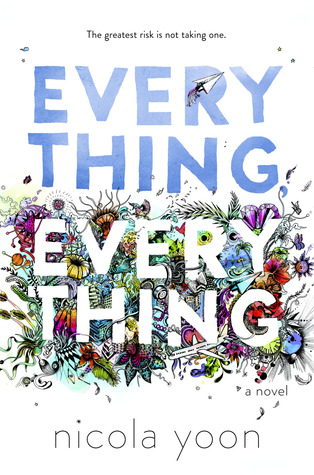
It's recently come to my attention that I love doing book reviews where I can talk about the movie or TV show adaptation as well (see Th1rteen R3asons Why by Jay Asher). I am planning to do a review of Simon vs. The Homo Sapiens Agenda as well, but I just finished Everything, Everything this morning and the ending gave me chills. I had to write about it right this second.
WARNING: SPOILERS ARE COMING. If you haven't read the book, you will learn things you shouldn't until the end of the book. Read the book or watch the movie, then come back and read this entry.
Title: Everything, Everything
Author: Nicola Yoon
Year Published: 2015
ISBN: 9780553496642
Interest Level: Grades 9-12
Plot Summary (From Goodreads):
My disease is as rare as it is famous. Basically, I’m allergic to the world. I don’t leave my house, have not left my house in seventeen years. The only people I ever see are my mom and my nurse, Carla.
But then one day, a moving truck arrives next door. I look out my window, and I see him. He’s tall, lean and wearing all black—black T-shirt, black jeans, black sneakers, and a black knit cap that covers his hair completely. He catches me looking and stares at me. I stare right back. His name is Olly.
Maybe we can’t predict the future, but we can predict some things. For example, I am certainly going to fall in love with Olly. It’s almost certainly going to be a disaster.
But then one day, a moving truck arrives next door. I look out my window, and I see him. He’s tall, lean and wearing all black—black T-shirt, black jeans, black sneakers, and a black knit cap that covers his hair completely. He catches me looking and stares at me. I stare right back. His name is Olly.
Maybe we can’t predict the future, but we can predict some things. For example, I am certainly going to fall in love with Olly. It’s almost certainly going to be a disaster.
I have to be honest when I tell you how my reading this book came about. I saw the movie and thought it was vapid, shallow, and not at all realistic. I mean, an 18-year-old gets approved for a credit card online and her first thought is to rack up huge debt flying to Hawaii with a boy she's known for a few weeks. Her mother is a doctor with a large settlement from the accidental death of her husband and son, but there's still no way she would be able to afford that huge, white, air-locked house with all kinds of specialized accommodations made for her daughter's illness in Southern California, plus paying a full-time nurse's salary and benefits. Mostly, it was like the movie writers had themselves never been out in the real world, and lived in a bubble where money doesn't exist and plane flights and air circulation systems just appear for free when you need them. But we have to explain where they came from, so sure, that seems like something you could charge on a credit card with no spending limit from a magical credit card company who never sends bills.
I left the movie theater feeling cheated, to be honest. I had heard nothing but good things about this book by Nicola Yoon, and while I hadn't read it yet, I couldn't imagine Hollywood would screw it up too badly. I should have used my past experiences hating almost every movie adaptation I've ever seen and saved my $13.
My negative feelings about the movie is why I saw it in May 2017 and just got around to reading the book this week. I wasn't planning to read it at all, but a little voice in the back of my head kept telling me to try it. "Don't donate that copy you bought on sale at Target," it whispered. "Pick it up and read the first 20 pages." So, I did.
The book still doesn't make my list of all-time favorites, but oh my god, it was SO MUCH BETTER than the movie (as if anyone is surprised. The book it always better).
When I reviewed Th1rteen R3asons Why, I said the 13-episode TV series could have been pared down to a feature-length film. I feel the exact opposite way about Everything, Everything. The movie didn't go into nearly enough detail. I would, without hesitation, binge a 13-episode series based on this book.
The beauty of this book is in the details, and we see almost none of them on screen. The reader sees pages from Madeline's journal, IM conversations between Madeline and Olly, pictures of plane tickets, entries from Madeline's blog, and most importantly, the inscriptions she writes in all of her books. This is a small detail, but by the end of the book it has become integral to the plot. After Mady (spoiler) finds out she isn't really sick and (spoiler) goes to New York to find Olly, she sets up her copy of The Little Prince for him to "find" in a used book store.

The last words in the book are "Found your book," spoken by Olly, the implication being that they now get to be together (forever? As much forever as you can find in a teen book?). We get NONE OF THIS in the movie.
I'm not saying the book is a masterpiece, but I would say I high-level-liked/low-level-loved the book, while I only tolerated the movie.
I am passionate about Zach because he understands the lives of both Madeline and Olly in a way that those two characters might not even understand, themselves. He has seen firsthand the evolution of Olly's family from loving to nuclear, and knows what it's like when your parents don't understand you. He would also be capable of helping Mady navigate the world she knows nothing about through the lens of being a person of color. (In the movie Madeline's mom is black, but in the book, they allude to her being light skinned and something other than black). Madeline's only experience with society is through her computer; she's never had a stranger judge her for the color of her skin or ask to touch her hair, because she's never met a stranger. An elongated friendship with Zach would be helpfully educational when it comes to aspects of black culture that she has missed. Also, getting more symbolic, Zach feels figuratively trapped in the oppressive walls of his family and can identify with Mady being literally trapped in her home.
I feel like I should address the elephant in the room: Madeline's illness. Or, spoiler, lack thereof. Madeline has grown up thinking she has SCID, an incredibly rare autoimmune disorder that comes with environmental triggers that can be fatal. For this reason, her mother has rigged their house with an airlock and multiple decontamination systems that separate Madeline from the outside. Even though Madeline is the narrator, and this is a YA novel, and teens are supposed to read it and identify with the love story between Mady and Olly, I feel like this is really a story about Madeline's mother.
Madeline's mother lost almost everything when her husband and son died. She was left with only baby, chronically ill Madeline. Of course, her instinct was to keep Mady safe and healthy so she didn't lose the one family member she had left. She let this instinct eat away at her until it was her only personality trait; it was everything. She perpetuates this lie throughout her daughter's entire life. She never lets her daughter go outside. Her daughter will never have a first day of kindergarten. A prom. A best friend. She has convinced herself that even though her daughter's entire life will take place inside the walls of their home, it's okay because she won't be dead. Madeline decides the opposite when she (spoiler) decides to run away.
Madeline's mother would rather her daughter survive than live. Madeline herself risks her own survival to thrive in the real world for even a short period of time.
If the book were longer, or if the intended audience weren't teenagers, maybe Yoon would go into this part of it. I do know that Munchhausen by Proxy and SCID awareness groups are not happy with the way either disorder is depicted in the book; maybe if they were portrayed more realistically these ideas would be expanded upon as well.
As it stands, I would give the book a solid 7/10. Could be better, but I've definitely started and never finished much worse novels.
Madeline's mother lost almost everything when her husband and son died. She was left with only baby, chronically ill Madeline. Of course, her instinct was to keep Mady safe and healthy so she didn't lose the one family member she had left. She let this instinct eat away at her until it was her only personality trait; it was everything. She perpetuates this lie throughout her daughter's entire life. She never lets her daughter go outside. Her daughter will never have a first day of kindergarten. A prom. A best friend. She has convinced herself that even though her daughter's entire life will take place inside the walls of their home, it's okay because she won't be dead. Madeline decides the opposite when she (spoiler) decides to run away.
Madeline's mother would rather her daughter survive than live. Madeline herself risks her own survival to thrive in the real world for even a short period of time.
If the book were longer, or if the intended audience weren't teenagers, maybe Yoon would go into this part of it. I do know that Munchhausen by Proxy and SCID awareness groups are not happy with the way either disorder is depicted in the book; maybe if they were portrayed more realistically these ideas would be expanded upon as well.
As it stands, I would give the book a solid 7/10. Could be better, but I've definitely started and never finished much worse novels.